
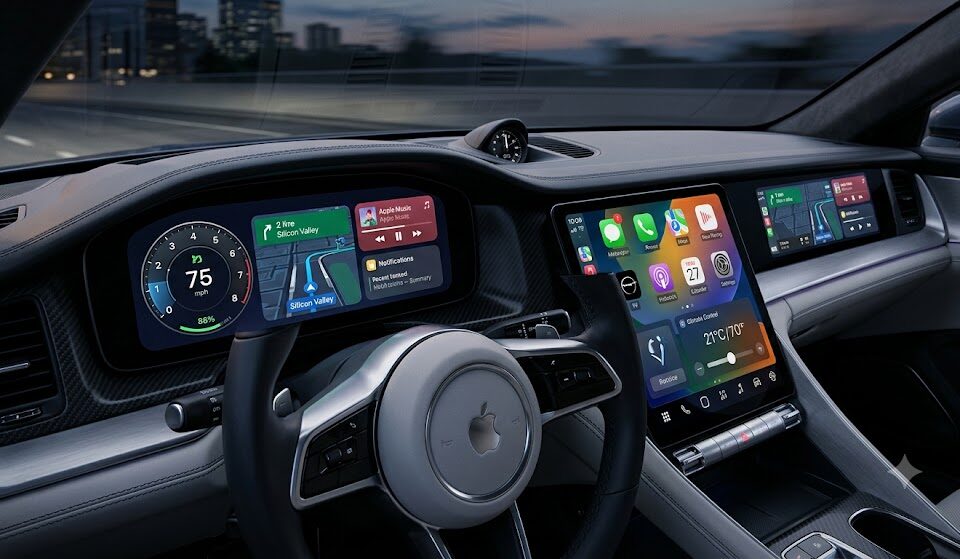
The Battle for Your Dashboard: Is Next-Gen Apple CarPlay Tech Taking Over the Soul of Luxury Cars?

When Apple officially shuttered its decade-long autonomous electric vehicle project, codenamed Project Titan, the automotive industry drew a collective sigh of relief. Detroit, Stuttgart, and Tokyo no longer had to worry about an “iCar” disrupting their market share.
However, Apple didn’t actually abandon the automotive space. Instead of building the hardware, tech giants are expanding their software empires. As we dive into 2026, the real war is being fought not on the tarmac, but directly on your dashboard.
The weapon of choice? Next-Generation Apple CarPlay. And it is forcing legacy automakers to make a brutal choice: surrender their screens to Silicon Valley, or risk alienating tech-savvy buyers.
What is Next-Gen CarPlay, and Why is It Controversial?
Traditional CarPlay is essentially a safe projection of your iPhone onto a single infotainment screen. It handles your maps, your Spotify playlists, and your text messages.
Next-Gen CarPlay is entirely different. It requires deep system integration, allowing Apple’s software to take over every single screen in the vehicle, including the driver’s instrument cluster, passenger screens, and climate control panels.
- The Tech Interactivity: It doesn’t just display apps; it reads the car’s native data. Next-Gen CarPlay displays your digital speedometer, monitors your EV battery level, tracks tire pressure, and directly adjusts the vehicle’s dual-zone climate control.
- The Customization: Drivers can completely skin their vehicle’s dashboard using Apple’s highly polished widgets and classic typography, making a British luxury cruiser or a German sports car interior look and feel like an extended iOS ecosystem.
The Great Divide: Who is In, and Who is Out?
The automotive world has fractured into two distinct camps regarding this digital invasion:
Camp 1: The Surrender (Porsche, Aston Martin, Audi)
Ultra-luxury brands like Aston Martin and Porsche were the first to roll out bespoke Next-Gen CarPlay environments. For these heritage brands, their core competency lies in driving dynamics, roaring powertrains, and chassis engineering—not coding software interfaces. By letting Apple handle the user experience, they give their ultra-wealthy clients a seamless, bug-free ecosystem that matches the premium nature of the vehicle.
Camp 2: The Resistance (Tesla, General Motors, Rivian)
On the other side of the ring stand Tesla, Rivian, and General Motors. GM famously made headlines by entirely banning Apple CarPlay and Android Auto from its newer EV lineups, forcing buyers to use its built-in Android Automotive-based system.
Why the resistance? Data and Revenue. If Apple controls the dashboard, Apple controls the data. Automakers want to monetize their vehicles via over-the-air upgrades, subscription services (like advanced navigation or heated seats), and in-car commerce. Giving that real estate to Apple means giving away billions in potential future revenue.
Dashboards in 2026: Built-In OS vs. Next-Gen CarPlay
| Feature | Next-Gen Apple CarPlay | Factory Native OS (e.g., Tesla/GM) |
| Ecosystem Unity | Perfect integration with iPhone/Apple Watch | Isolated to the car’s specific hardware |
| User Interface | Highly fluid, unified iOS design aesthetics | Varies wildly; can feel clunky on legacy brands |
| Subscription Fees | Free (Powered by your phone) | Often tied to monthly automaker data plans |
| Data Privacy | Managed via Apple privacy standards | Collected directly by the car manufacturer |
The Verdict: Will Consumers Side with the Silicon Valley?
For the average driver in 2026, the choice comes down to personal convenience. Automakers who refuse to support advanced smartphone projection are betting that their software engineers can build something better than Apple or Google. While Tesla has successfully pulled this off, legacy brands are still struggling to deliver glitch-free, intuitive infotainment systems.
One thing is certain: your next car purchase might not depend on horsepower or fuel economy, but on which tech ecosystem you want to live in while sitting in traffic.
Would you refuse to buy a premium EV if it didn’t support Apple CarPlay? Or do you prefer the manufacturer’s native smart dashboard? Let us know your thoughts in the comments below!