
The definition of a “supercar” is undergoing a violent evolution. For decades, the recipe was simple: a roaring multi-cylinder internal combustion engine, a lightweight European chassis, and a price tag that could buy a mansion.
But as we cruise through 2026, the elite automotive stratosphere has split into two parallel universes. In one universe, bleeding-edge quad-motor electric tech is reshaping physics. In the other, motorsport heritage and high-revving internal combustion engines are making a glorious, roaring stand.
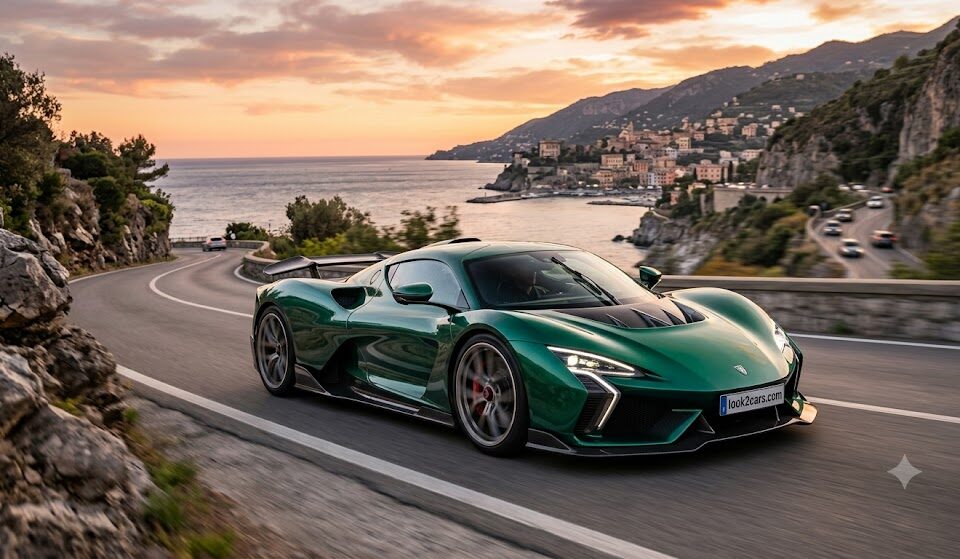
To see where the future of speed lies, we are pitting China’s technological disrupter, the BYD Yangwang U9, against Europe’s finest modern masterpieces: the hybrid McLaren W1 and the purist Ferrari 12Cilindri.
1. The Technological Disruptor: Yangwang U9
The Over-the-Top Electric Megacar
The Yangwang U9 is a rolling laboratory of what happens when you throw unlimited EV R&D at a carbon-fiber monocoque. Powered by BYD’s revolutionary e⁴ (YiSifang) platform, the U9 features four independent electric motors—one for each wheel.
- The Numbers: A mind-melting 1,300 horsepower and a 0–60 mph sprint executed in just 2.36 seconds.
- The Party Trick: It’s not just about straight-line speed. Thanks to the DiSus-X Intelligent Hydraulic Body Control System, the U9 can jump off the ground, dance to music, and track seamlessly around corners by adjusting the suspension stiffness and height millisecond by millisecond. It can even drive on three wheels if a tire blows out.
- The Reality: At roughly 2,475 kg (5,456 lbs), it is heavy for a supercar. However, the vectoring torque from its four motors manipulates that weight so aggressively that it challenges everything we know about cornering physics.
2. The Formula 1 Hybrid Royalty: McLaren W1
The Pinnacle of Track Engineering
Following in the legendary footsteps of the F1 and P1, McLaren’s flagship for this era—the W1—takes a completely different approach to speed. It doesn’t ditch the engine; it perfects it with motorsport-derived hybridization.
- The Numbers: Combining a twin-turbo V8 with a high-performance electric module, the W1 unleashes 1,258 horsepower sent strictly to the rear wheels. It rockets to 60 mph in 2.2 seconds and hits 186 mph (300 km/h) in a breathtaking 12.7 seconds.
- Why It’s a Masterpiece: Unlike the heavy electric U9, the W1 weighs just under 1,400 kg. It utilizes radical active aerodynamics, transforming its shape in “Race Mode” by dropping the ride height and extending an active rear wing to generate F1-level downforce.
- The Reality: It is a pure, unadulterated track weapon. It is built for the driver who wants the visceral feedback of a race car paired with sophisticated hybrid boost.
3. The Purist’s Last Stand: Ferrari 12Cilindri
The Symphony of Natural Aspiration
While others chase electrification, Maranello delivered a love letter to automotive purists: the Ferrari 12Cilindri. Named after its beating heart, this GT supercar refuses turbochargers and hybrid batteries entirely.
- The Numbers: A front-mid mounted, 6.5-liter naturally aspirated V12 screaming all the way to a 9,500 rpm redline, producing 819 horsepower. 0–60 mph happens in 2.9 seconds.
- Why It Matters: In 2026, a naturally aspirated V12 is an endangered species. The 12Cilindri isn’t trying to beat the U9 or W1 in a drag race; it is winning the battle for the human soul. The throttle response is instantaneous, and the exhaust note is an acoustic symphony that no electric motor can ever replicate.
Side-by-Side: The Clash of Philosophies
| Feature | Yangwang U9 | McLaren W1 | Ferrari 12Cilindri |
| Powertrain | Quad-Motor Pure EV | Twin-Turbo V8 Hybrid | Naturally Aspirated V12 |
| Horsepower | 1,300 hp | 1,258 hp | 819 hp |
| Weight | Heavy (~2,475 kg) | Light (~1,399 kg) | Grand Tourer (~1,560 kg) |
| Core Character | Digital Wizardry | Track Weapon | Analog Symphony |
The Verdict: How Do You Define Performance in 2026?
If you measure performance solely by digital matrixes, active hydraulic wizardry, and sheer acceleration from a standstill, the Yangwang U9 represents a jaw-dropping leap forward for Chinese automotive engineering.
If you want the absolute ultimate in track-day aerodynamics and lap-time dominance born from Formula 1, the McLaren W1 remains the poster car of a generation.
But if you believe that driving is an emotional, mechanical experience defined by the howl of an internal combustion engine climbing past 9,000 rpm, the Ferrari 12Cilindri is a timeless masterpiece that money can buy before the curtain falls on gasoline.
Are you backing the quad-motor electric future of the Yangwang U9, the hybrid precision of the McLaren W1, or the timeless V12 roar of the Ferrari 12Cilindri? Let us know your dream garage in the comments below!