
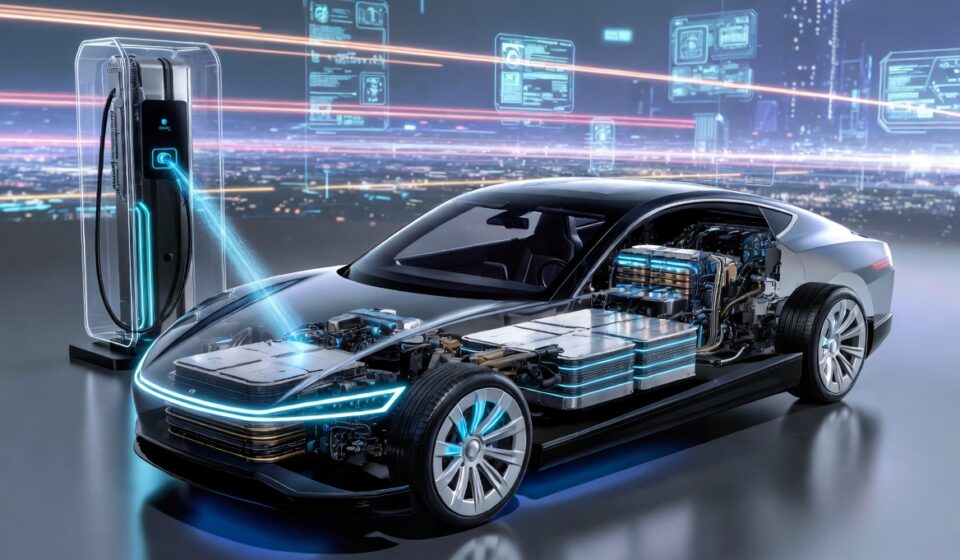
Solid-State Batteries Are Closer Than You Think: 1,000km Range Becomes Reality in 2026

For nearly a decade, the automotive industry has treated solid-state batteries (SSBs) like nuclear fusion—a revolutionary technology that is always “just five to ten years away.” Traditional lithium-ion batteries have served us well, but they are hitting their theoretical limits in energy density, charging speed, and thermal stability.
However, 2026 has officially become the inflection point. The narrative is shifting rapidly from “if” to “when,” as multi-billion-dollar investments, market listings, and pilot production lines prove that solid-state power is no longer a distant dream.
The Breakthroughs of 2026: Real-World Testing and Public Markets
The momentum behind SSBs has reached a fever pitch this month. Just days ago, US-based solid-state pioneer Factorial Energy made headlines by debuting on the Nasdaq after a massive merger, demonstrating the sheer scale of capital backing this technology.
What is driving this investor confidence? Real-world validation. Factorial recently showcased a modified luxury EV capable of delivering a staggering 745 miles (over 1,200 km) of real-world driving range on a single charge. Backed by automotive heavyweights like Mercedes-Benz, Stellantis, and Hyundai, the company’s 375 Wh/kg cells are reportedly a third of the size of traditional lithium-ion packs and 40% lighter, while unlocking a 50% longer driving range.
Meanwhile, the race in Asia is accelerating. Global EV giants are targeting late 2026 and 2027 for the first wave of true mass-production implementations. From Dongfeng’s aggressive production timeline to BYD’s intensive R&D into sulfide-based solid-state chemistry, manufacturers are pushing the boundaries of what is possible.
Why Solid-State Changes Everything
To understand why automakers are pouring billions into this tech, we have to look at the massive upgrades it brings over liquid-electrolyte batteries:
- True 1,000km+ Range: By replacing the liquid electrolyte with solid materials and using lithium-metal or silicon anodes, energy densities can easily breach the 400-500 Wh/kg threshold, effectively doubling current EV ranges without adding weight.
- Extreme Fast Charging: Solid electrolytes tolerate much higher charging temperatures and currents without decomposing. Companies are now testing cells capable of an 80% charge in just 9 to 15 minutes (hitting discharge rates up to 4C).
- Uncompromising Safety: Liquid electrolytes are inherently flammable. SSBs virtually eliminate the risk of thermal runaway, making EVs significantly safer in the event of severe impacts.
The Three-Phase Rollout: Where Are We Now?
The transition to solid-state is happening in waves, and understanding this timeline is key for anyone looking to buy an EV in the near future:
| Phase | Technology | Timeline / Status | Noteworthy Players |
| Phase 1 | Semi-Solid Batteries (5–15% liquid) | Currently Active | Nio, IM Motors |
| Phase 2 | Initial Solid-State Production | Late 2026 – 2027 | Dongfeng, Factorial, Nissan |
| Phase 3 | True Gigafactory Mass Production | 2027 – 2030 | Toyota, CATL, Samsung SDI |
Interestingly, the technology is even transcending the automotive realm. Because premium pricing isn’t as strict a barrier in advanced aerospace, Chinese eVTOL (flying car) startups have already begun betting heavily on solid-state cells to double their flight ranges, meaning the technology might hover over our cities before it dominates our highways.
The Verdict: Should You Wait to Buy an EV?
If you are planning to buy a premium electric vehicle in the next 18 months, the solid-state revolution will likely affect the ultra-luxury segment first. For the mass market, standard lithium-ion and lithium-iron-phosphate (LFP) batteries will remain dominant due to cost-efficiency.
However, 2026 has proven that the ceiling for electric mobility has officially been shattered. The 1,000-kilometer range road trip is no longer a marketing gimmick—it’s rolling off the production line.
What do you think about the timeline of solid-state batteries? Would you hold off on buying a new EV until this technology goes mainstream? Let us know in the comments below!


Hi, this is a comment.
To get started with moderating, editing, and deleting comments, please visit the Comments screen in the dashboard.
Commenter avatars come from Gravatar.